
Category: Programming

  • An In-Depth Guide to Object-Oriented Programming in Python for Beginners

    An In-Depth Guide to Object-Oriented Programming in Python for Beginners

    Object-oriented programming (OOP) is a powerful and widely used programming paradigm that helps you design and organize your code in a more structured and modular way. Python, a popular and versatile programming language, fully supports OOP concepts, making it an excellent choice for both beginners and experienced developers. In this comprehensive guide, we’ll explore the fundamentals of OOP in Python with plenty of coding examples to help you get started.

    What is Object-Oriented Programming?

    At its core, OOP is a programming paradigm that models real-world entities and their interactions using objects. An object is a self-contained unit that bundles both data (attributes) and behavior (methods) into a single entity. These objects can be used to represent and manipulate data in a clean and organized manner.

    Classes and Objects

    In Python, everything is an object. You can create your own custom objects by defining classes. A class is like a blueprint for creating objects. It defines the attributes (data) and methods (functions) that objects of that class will have.

    Let’s create a simple class to illustrate this concept:

    class Dog:
        def __init__(self, name, breed):
            self.name = name
            self.breed = breed
    
        def bark(self):
            print(f"{self.name} is barking!")
    
    # Create instances of the Dog class
    dog1 = Dog("Buddy", "Golden Retriever")
    dog2 = Dog("Sadie", "Poodle")
    
    # Accessing attributes
    print(dog1.name)  # Output: Buddy
    
    # Calling methods
    dog2.bark()  # Output: Sadie is barking!
    

    In the code above, we defined a Dog class with two attributes (name and breed) and a method (bark). We then created two instances of the Dog class (dog1 and dog2) and demonstrated how to access attributes and call methods on these objects.

    Inheritance

    One of the core principles of OOP is inheritance, which allows you to create a new class by inheriting attributes and methods from an existing class. The new class is known as a subclass, while the original class is called a superclass.

    Let’s see an example of inheritance in Python:

    class Animal:
        def __init__(self, name):
            self.name = name
    
        def speak(self):
            pass  # This method will be overridden in subclasses
    
    class Dog(Animal):
        def speak(self):
            return f"{self.name} says Woof!"
    
    class Cat(Animal):
        def speak(self):
            return f"{self.name} says Meow!"
    
    # Create instances of subclasses
    dog = Dog("Buddy")
    cat = Cat("Whiskers")
    
    # Call the speak method
    print(dog.speak())  # Output: Buddy says Woof!
    print(cat.speak())  # Output: Whiskers says Meow!
    

    In this example, we have a superclass Animal with a speak method, which is then overridden in the subclasses Dog and Cat. This allows us to customize the behavior of each subclass while reusing the common attributes and methods from the superclass.

    Encapsulation

    Encapsulation is the concept of bundling data (attributes) and the methods that operate on that data into a single unit (i.e., the object). In Python, encapsulation is achieved using private and protected attributes and methods.

    • Private attributes and methods are denoted by a double underscore prefix, such as __private_var. These are not accessible from outside the class.
    • Protected attributes and methods are denoted by a single underscore prefix, like _protected_var. They are intended to be used within the class and its subclasses but are still accessible from outside.

    Here’s an example:

    class Circle:
        def __init__(self, radius):
            self.__radius = radius  # Private attribute
    
        def _calculate_area(self):  # Protected method
            return 3.14 * self.__radius * self.__radius
    
        def get_area(self):  # Public method
            return self._calculate_area()
    
    # Create a Circle object
    circle = Circle(5)
    
    # Accessing a public method
    print(circle.get_area())  # Output: 78.5
    
    # Attempting to access a private attribute (will result in an error)
    # print(circle.__radius)  # Error: 'Circle' object has no attribute '__radius'
    

    In this example, the Circle class has a private attribute __radius, a protected method _calculate_area, and a public method get_area. The private attribute is not accessible from outside the class, while the public method allows us to access the calculated area.

    Polymorphism

    Polymorphism is the ability of different objects to respond to the same method in a way that is appropriate for their specific class. This allows for more flexible and modular code.

    Let’s demonstrate polymorphism with an example:

    class Bird:
        def speak(self):
            pass
    
    class Parrot(Bird):
        def speak(self):
            return "Squawk!"
    
    class Crow(Bird):
        def speak(self):
            return "Caw!"
    
    # Create instances of different bird species
    parrot = Parrot()
    crow = Crow()
    
    # Use polymorphism to call the speak method
    birds = [parrot, crow]
    
    for bird in birds:
        print(bird.speak())  # Output: Squawk!  Caw!
    

    In this example, we have a base class Bird with a speak method, and two subclasses Parrot and Crow that override the speak method. We then create instances of these subclasses and use polymorphism to call the speak method, which behaves differently for each bird species.

    Conclusion

    Object-oriented programming is a fundamental concept in Python and many other programming languages. It provides a structured and modular approach to software development, making code easier to manage, maintain, and extend.

    In this guide, we’ve covered the basics of OOP in Python, including classes, objects, inheritance, encapsulation, and polymorphism. These concepts are essential for building robust and maintainable Python applications. As you continue your journey in Python programming, you’ll find that OOP is a valuable tool for organizing and structuring your code effectively.


  • Unlocking the Power of Rust: An Introduction to the Modern Programming Language

    Unlocking the Power of Rust: An Introduction to the Modern Programming Language

    In the vast landscape of programming languages, there are few that stand out for their unique blend of performance, memory safety, and concurrency. Rust, a relatively young language born out of Mozilla Research, has quickly gained traction among developers due to its exceptional capabilities and focus on system-level programming. In this article, we will embark on a journey to explore the fundamentals of Rust, understanding its key features, syntax, memory management, and how it differs from other popular programming languages. Whether you’re a seasoned developer or a newcomer to the coding world, Rust’s elegance and power are sure to captivate your imagination.

    The Birth of Rust

    Rust’s origins can be traced back to 2006 when Mozilla Research launched the “Mozilla Research Language” project. The language’s development was driven by the desire to address the challenges of concurrent programming and memory safety in systems programming languages. In 2010, the project was officially named Rust, inspired by the rust-resistant nature of iron oxide and its goal to protect against memory-related bugs.

    Safety First: The Borrow Checker and Ownership

    One of Rust’s defining features is its strict approach to memory management through the “borrow checker” and ownership model. Unlike traditional languages, where developers rely on garbage collection or manual memory management, Rust’s borrow checker analyzes code at compile time to ensure memory safety. It prevents common pitfalls such as null pointer dereferences and data races, making Rust a robust choice for writing safe and reliable code.

    Expressive and Powerful Syntax

    Rust’s syntax is a fusion of C++ and functional programming concepts, making it expressive and concise. Its pattern matching and algebraic data types facilitate elegant solutions to complex problems. Additionally, Rust’s modern design embraces conventions that enhance readability, making it easier for developers to understand and maintain codebases.

    Performance without Sacrifice

    Rust’s emphasis on performance is evident through its “zero-cost abstractions” philosophy. Unlike languages that rely heavily on runtime checks and abstractions that come at a performance cost, Rust ensures that developers pay only for the features they use. By minimizing runtime overhead, Rust enables high-performance applications without sacrificing safety and readability.

    Concurrency Made Simple with ‘async/await’

    Rust empowers developers to harness the full potential of modern hardware through concurrency. The introduction of ‘async/await’ syntax allows for efficient and straightforward asynchronous programming. Rust’s built-in support for concurrency enables developers to write scalable, responsive, and resource-efficient applications.

    The Growing Rust Ecosystem

    Despite being a relatively young language, Rust’s ecosystem has grown substantially. Its package manager, Cargo, simplifies dependency management and project setup. With an ever-expanding repository of crates (Rust’s term for libraries), developers can readily find solutions for various use cases, from web development to networking and beyond.

    Community and Support

    Rust’s vibrant community plays a pivotal role in its success. With an emphasis on inclusivity, documentation, and community-driven decision-making, Rust’s developers actively engage with newcomers and experienced programmers alike. This welcoming atmosphere fosters collaboration, making learning Rust an enjoyable experience.

    Conclusion

    In conclusion, Rust is a modern programming language that strikes a delicate balance between performance and safety, making it an ideal choice for system-level programming, embedded devices, and performance-critical applications. With its unique borrow checker and ownership model, Rust eliminates the fear of memory-related bugs and empowers developers to create highly efficient, concurrent, and safe code.

    As the Rust ecosystem continues to flourish, more developers are discovering the power and elegance of this language. Its expressive syntax, robust safety guarantees, and community-driven development process make Rust an exciting and attractive option for tackling modern programming challenges.

    Whether you’re looking to optimize performance-critical software, build secure systems, or explore the frontiers of concurrent programming, Rust stands ready to unlock new horizons in the world of software development. Embrace Rust’s journey, and you’ll find yourself equipped with a powerful and futuristic toolset that will shape the next generation of software solutions.

  • The Neural Nexus: Unraveling the Power of Activation Functions in Neural Networks

    The Neural Nexus: Unraveling the Power of Activation Functions in Neural Networks

    In the realm of neural networks, one of the most crucial yet often overlooked components is the activation function. As the “neural switch,” activation functions play a fundamental role in shaping the output of individual neurons and, by extension, the overall behavior and effectiveness of the network. They are the key to introducing nonlinearity into neural networks, enabling them to model complex relationships in data and solve a wide range of real-world problems. In this comprehensive article, we delve deep into the fascinating world of activation functions, exploring their significance, various types, and the impact they have on training and performance. By understanding the neural nexus, we gain valuable insights into the art and science of designing powerful neural networks that fuel the advancement of artificial intelligence.

    The Foundation of Activation Functions

    At the core of every neural network, artificial neurons process incoming information and produce an output signal. The output of a neuron is determined by applying an activation function to the weighted sum of its inputs and biases. This process mimics the firing behavior of biological neurons in the brain, where the neuron activates or remains inactive based on the input signal’s strength.

    The Role of Nonlinearity

    The key role of activation functions lies in introducing nonlinearity into the neural network. Without nonlinearity, the network would be reduced to a series of linear transformations, incapable of modeling complex patterns in data. Nonlinear activation functions enable the composition of multiple non-linear functions, allowing the network to approximate highly intricate mappings between inputs and outputs. As a result, neural networks become capable of solving a wide range of problems, from image recognition and natural language processing to medical diagnosis and financial prediction.

    The Landscape of Activation Functions

    This section explores various types of activation functions that have been developed over the years. We start with the classic step function, which was one of the earliest activation functions used. However, due to its discontinuity and lack of differentiability, the step function is rarely used in modern neural networks.

    Next, we delve into the widely-used Sigmoid function. The Sigmoid function maps the entire input range to a smooth S-shaped curve, effectively squashing large positive and negative inputs to the range (0, 1). While the Sigmoid function provides nonlinearity, it suffers from the vanishing gradient problem. As the output approaches the extremes (0 or 1), the gradient becomes extremely small, leading to slow learning or getting stuck in training.

    The Hyperbolic Tangent (TanH) function is another popular activation function that addresses the vanishing gradient issue of the Sigmoid. The TanH function maps the input range to (-1, 1), allowing for stronger gradients and faster learning. However, TanH still suffers from the vanishing gradient problem, particularly for large inputs.

    The Rectified Linear Unit (ReLU) is one of the most widely used activation functions in modern neural networks. ReLU maps the input to zero for negative values and leaves positive values unchanged. ReLU effectively solves the vanishing gradient problem for positive inputs, as its gradient is 1 for positive values, enabling faster convergence. However, ReLU can suffer from the “dying ReLU” problem, where neurons can become inactive and never recover from negative inputs.

    To mitigate the issues of ReLU, researchers introduced variants like Leaky ReLU and Parametric ReLU. Leaky ReLU introduces a small, non-zero slope for negative inputs, preventing neurons from becoming inactive. Parametric ReLU takes this a step further by allowing the slope to be learned during training, making it more adaptive to the data.

    Advanced activation functions like Exponential Linear Units (ELUs) and Swish have been proposed to improve on the drawbacks of ReLU. ELUs introduce smoothness to the function, preventing the “dying ReLU” problem and providing faster convergence. Swish combines the simplicity of ReLU with a smooth S-shaped curve, offering better performance on certain tasks.

    Activation Functions in Action – Coding Examples

    To grasp the practical implications of activation functions, let’s look at coding examples demonstrating how they affect neural network behavior. We will use Python and the popular deep learning library TensorFlow/Keras for implementation. We’ll create a simple neural network with one hidden layer and experiment with different activation functions.

    import numpy as np
    import matplotlib.pyplot as plt
    import tensorflow as tf
    
    # Generate sample data
    X = np.linspace(-5, 5, 1000).reshape(-1, 1)
    
    # Create a neural network model with one hidden layer
    model = tf.keras.Sequential([
        tf.keras.layers.Dense(64, activation='linear', input_shape=(1,)),
        tf.keras.layers.Activation('relu'),
        tf.keras.layers.Dense(1, activation='linear')
    ])
    
    # Compile the model with an appropriate optimizer and loss function
    model.compile(optimizer='adam', loss='mse')
    
    # Train the model
    history_relu = model.fit(X, X, epochs=1000, verbose=0)
    
    # Change activation function to Swish
    model.layers[1].activation = tf.keras.activations.swish
    
    # Recompile the model
    model.compile(optimizer='adam', loss='mse')
    
    # Train the model with Swish
    history_swish = model.fit(X, X, epochs=1000, verbose=0)
    
    # Plot the training loss for both ReLU and Swish
    plt.plot(history_relu.history['loss'], label='ReLU')
    plt.plot(history_swish.history['loss'], label='Swish')
    plt.xlabel('Epochs')
    plt.ylabel('Loss')
    plt.title('Comparison of ReLU and Swish Activation Functions')
    plt.legend()
    plt.show()
    
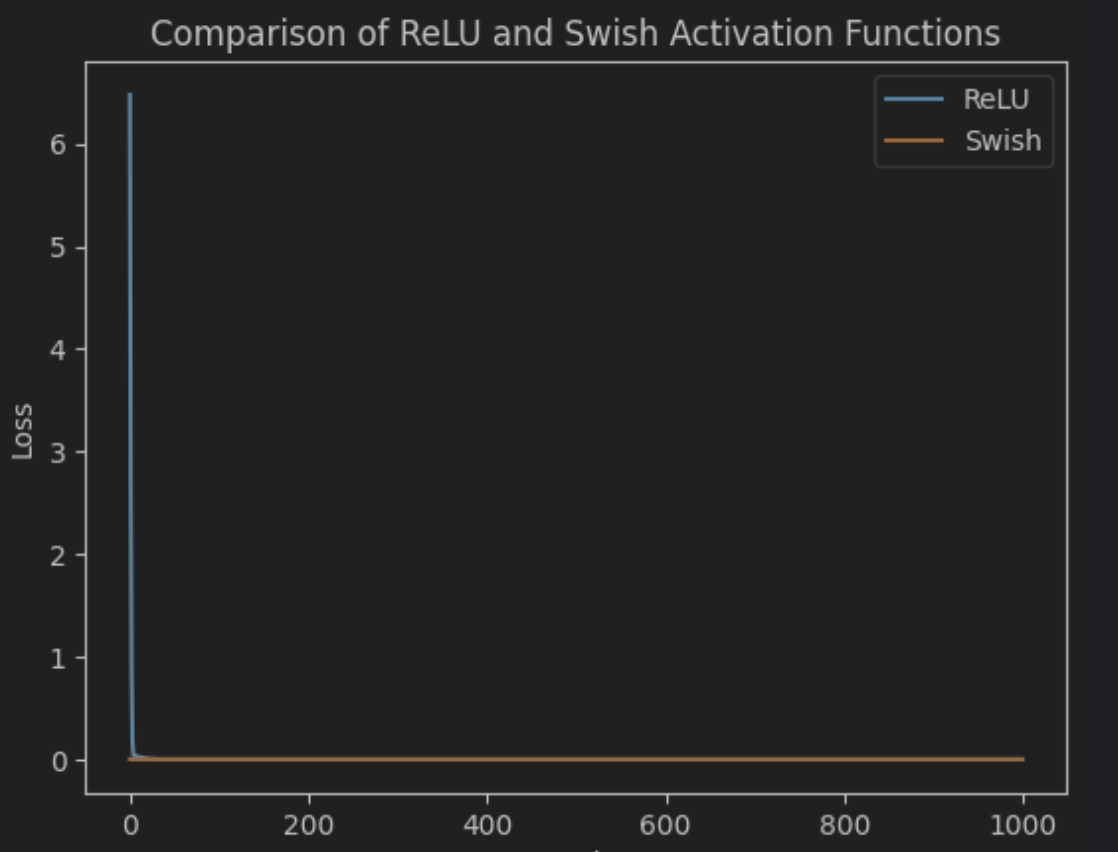
    Comparison of ReLU and Swish Activation Functions

    In this example, we compare the training loss of a neural network using ReLU and Swish activation functions. We observe how Swish converges faster and achieves a lower loss compared to ReLU.

    The Impact on Training and Performance

    Different activation functions significantly affect the training dynamics of neural networks. The choice of activation function impacts the network’s convergence speed, gradient flow, and ability to handle vanishing or exploding gradients.

    In the coding example above, we observed how Swish outperformed ReLU in terms of convergence speed and loss. While both activation functions achieved good results, Swish exhibited better behavior during training.

    To gain a deeper understanding, we can create additional experiments to compare the performance of activation functions on different tasks and architectures. For instance, some activation functions may perform better on image classification tasks, while others excel in natural language processing tasks.

    Adaptive Activation Functions

    To address some limitations of traditional activation functions, researchers have explored adaptive approaches. The Swish activation function, for example, is a hybrid of ReLU and the Sigmoid function, and it automatically adapts to the characteristics of the data.

    Another adaptive activation function is the Adaptive Piecewise Linear (APL) activation. This function learns the slope and intercept of each activation during training, allowing for better adaptability to different data distributions.

    These adaptive activation functions aim to strike a balance between computation efficiency, gradient behavior, and performance on diverse tasks, making them valuable additions to the arsenal of activation functions.

    Activation Functions in Advanced Architectures

    Activation functions play a pivotal role in more advanced architectures like residual networks (ResNets) and transformers. In residual networks, the identity shortcut connections are particularly effective in mitigating the vanishing gradient problem, enabling deeper and more efficient networks. Such architectures leverage activation functions to maintain gradient flow across layers and ensure smooth training.

    In transformers, the self-attention mechanism enables capturing long-range dependencies in data. Activation functions in transformers contribute to modeling the interactions between different tokens in the input sequence, allowing the network to excel in natural language processing tasks.

    The Quest for the Ideal Activation Function

    While the field of activation functions has witnessed significant progress, the quest for the ideal activation function continues. Researchers are constantly exploring new activation functions, aiming to strike a balance between computation efficiency, gradient behavior, and performance on diverse tasks.

    The ideal activation function should be able to alleviate the vanishing gradient problem, promote faster convergence, and handle a wide range of data distributions. Additionally, it should be computationally efficient and avoid issues like the “dying ReLU” problem.

    The choice of activation function is also heavily influenced by the network architecture and the specific task at hand. Different activation functions may perform better or worse depending on the complexity of the problem and the data distribution.

    Comparison Summary

    To summarize the comparison of various activation functions:

    1. Sigmoid and TanH functions: Both suffer from the vanishing gradient problem, making them less suitable for deep networks. They are rarely used as hidden layer activations in modern networks.
    2. ReLU and its variants (Leaky ReLU, Parametric ReLU): ReLU is widely used due to its simplicity and faster convergence for positive inputs. Leaky ReLU and Parametric ReLU variants aim to address the “dying ReLU” problem and achieve better performance in certain scenarios.
    3. ELU and Swish functions: ELU introduces smoothness and avoids the “dying ReLU” problem, while Swish combines the simplicity of ReLU with better performance.
    4. Adaptive activation functions (Swish and APL): These functions automatically adapt to the data, making them suitable for a wide range of tasks and data distributions.

    Conclusion

    Activation functions are the unsung heroes of neural networks, wielding immense influence over the learning process and network behavior. By introducing nonlinearity, these functions enable neural networks to tackle complex problems and make remarkable strides in the field of artificial intelligence. Understanding the nuances and implications of different activation functions empowers researchers and engineers to design more robust and efficient neural networks, propelling us ever closer to unlocking the full potential of AI and its transformative impact on society. As the quest for the ideal activation function continues, the neural nexus will continue to evolve, driving the progress of artificial intelligence toward new frontiers and uncharted territories.

  • Unraveling the Enigma: An Introduction to Neural Networks

    Unraveling the Enigma: An Introduction to Neural Networks

    In the ever-evolving realm of artificial intelligence, one powerful concept stands at the forefront, shaping the future of intelligent systems – neural networks. These complex computational models, inspired by the intricate workings of the human brain, have revolutionized various industries and applications, from natural language processing and computer vision to finance and marketing. This comprehensive article delves deep into the essence of neural networks, exploring their historical evolution, core components, training algorithms, challenges, advancements, and real-life applications, all while providing coding examples to demystify their inner workings.

    The Genesis of Neural Networks

    The journey of neural networks begins in the 1940s when Warren McCulloch and Walter Pitts proposed the first artificial neurons, simple computational units inspired by the biological neurons in our brains. Building on this foundation, Frank Rosenblatt introduced the perceptron in the late 1950s, a single-layer neural network capable of learning simple patterns. Although it demonstrated potential, the perceptron’s limitations and the complexity of training deeper networks led to a period known as the “AI Winter.”

    It wasn’t until the 1980s that significant progress was made, thanks to the backpropagation algorithm, which enabled efficient training of multi-layer neural networks. This breakthrough paved the way for the modern resurgence of neural networks and the dawn of the era of deep learning in the 21st century.

    Unraveling the Neural Structure

    Understanding the architecture of neural networks is essential to grasp their functionality. We’ll start by exploring the fundamental building block: the artificial neuron. These neurons receive input data, apply a weight to each input, sum them up, and then pass the result through an activation function to produce an output.

    To illustrate this concept, let’s delve into a coding example using Python and popular libraries like NumPy and TensorFlow/Keras:

    import numpy as np
    import tensorflow as tf
    
    # Example input data
    input_data = np.array([2, 3, 1])
    
    # Example weights
    weights = np.array([0.5, -0.3, 0.8])
    
    # Calculate the weighted sum
    weighted_sum = np.dot(input_data, weights)
    
    # Apply activation function (ReLU in this case)
    output = max(0, weighted_sum)
    
    print("Output:", output)
    

    This example demonstrates a basic artificial neuron that performs a weighted sum of the input data and applies the Rectified Linear Unit (ReLU) activation function.

    Next, we’ll explore more complex architectures like feedforward neural networks, which consist of input, hidden, and output layers. We’ll discuss the concept of deep neural networks, where multiple hidden layers enable the network to learn hierarchical representations of the input data. Additionally, we’ll introduce convolutional neural networks (CNNs) for image processing tasks and recurrent neural networks (RNNs) for sequential data analysis.

    Training the Network: The Art of Learning

    Training neural networks involves fine-tuning their weights and biases to make accurate predictions. The process starts with feeding input data forward through the network (forward propagation) to generate predictions. Then, the model’s performance is evaluated using a loss function that quantifies the prediction error. The goal is to minimize this error during training.

    To achieve this, the backpropagation algorithm calculates the gradient of the loss function with respect to each weight and bias, enabling us to update them in the direction that minimizes the error. We iteratively perform forward and backward propagation using training data until the model converges to a state where it can generalize well to new, unseen data.

    Let’s illustrate the concept of training with a simple example using TensorFlow/Keras:

    import tensorflow as tf
    
    # Example dataset (features and labels)
    X_train = [...]  # Features
    y_train = [...]  # Labels
    
    # Create a neural network model
    model = tf.keras.Sequential([
        tf.keras.layers.Dense(64, activation='relu', input_shape=(input_dim,)),
        tf.keras.layers.Dense(32, activation='relu'),
        tf.keras.layers.Dense(output_dim, activation='softmax')
    ])
    
    # Compile the model with an appropriate optimizer and loss function
    model.compile(optimizer='adam', loss='categorical_crossentropy', metrics=['accuracy'])
    
    # Train the model
    model.fit(X_train, y_train, epochs=10, batch_size=32)
    

    This example demonstrates the creation and training of a simple feedforward neural network using TensorFlow/Keras.

    Challenges and Advancements

    While neural networks have achieved groundbreaking success, they are not without challenges. Overfitting, a phenomenon where the model performs well on training data but poorly on unseen data, remains a significant concern. To combat overfitting, techniques like dropout, which randomly deactivates neurons during training, and regularization, which penalizes large weights, have been introduced.

    Additionally, training deep neural networks can suffer from vanishing and exploding gradient problems, hindering convergence. Advancements like batch normalization and better weight initialization methods have greatly mitigated these issues.

    Real-World Applications

    Neural networks have become the backbone of various real-world applications. In healthcare, they are employed for disease diagnosis, medical image analysis, and drug discovery. In finance, they assist in fraud detection, stock market prediction, and algorithmic trading. In marketing, they optimize advertising campaigns and personalize customer experiences.

    One prominent real-world application of neural networks is natural language processing (NLP). Language models like GPT-3 have revolutionized language generation, translation, and sentiment analysis.

    Furthermore, neural networks have left their mark in computer vision, powering object detection, facial recognition, and autonomous vehicles. Notably, CNNs have dominated image-related tasks, showcasing their ability to learn complex features from raw pixel data.

    The Ethical Implications

    As neural networks become deeply ingrained in our daily lives, it is crucial to acknowledge the ethical implications surrounding their use. One of the primary concerns is bias in AI systems, which can lead to discriminatory outcomes, perpetuating social inequalities. Biased training data can inadvertently lead to biased predictions, affecting hiring decisions, loan approvals, and even criminal justice systems. Addressing bias in AI requires careful curation of training data, transparency in algorithms, and ongoing evaluation to ensure fair and equitable outcomes.

    Another ethical aspect is privacy and data security. Neural networks often require vast amounts of data for training, raising concerns about user privacy and data protection. Striking the right balance between data utilization and individual privacy rights is a significant challenge that policymakers and technologists must grapple with.

    Emerging Advancements and Future Directions

    The field of neural networks continues to evolve rapidly, with constant research and innovation pushing the boundaries of what these systems can achieve. Advanced architectures like Transformers have revolutionized NLP tasks, and novel techniques like self-supervised learning show great promise in reducing the need for extensive labeled data.

    As quantum computing and neuromorphic computing gain traction, neural networks stand to benefit from even more computational power, potentially enabling the development of more sophisticated and efficient models.

    Furthermore, interdisciplinary approaches are shaping the future of neural networks. Researchers are exploring the fusion of neuroscience with AI to develop biologically-inspired models, bridging the gap between artificial and natural intelligence.

    The Journey Continues

    The journey into the realm of neural networks is far from over. As we gain a deeper understanding of their inner workings, explore novel architectures, and tackle new challenges, the potential applications seem boundless. Neural networks have revolutionized industries, empowered individuals, and offered solutions to problems once considered insurmountable.

    In the quest to harness the true potential of neural networks, collaboration between experts from various domains is essential. The future of AI lies not just in the hands of data scientists and engineers but also in those of ethicists, psychologists, sociologists, and policymakers. Working together, we can ensure that neural networks continue to shape a future that benefits humanity as a whole.

    Conclusion

    Neural networks have undoubtedly emerged as a cornerstone of modern artificial intelligence, unlocking a world of possibilities across countless domains. Their historical evolution, from the pioneering work of the past to the cutting-edge advancements of today, showcases the remarkable progress achieved in understanding and leveraging these complex systems.

    As we embrace neural networks in real-world applications, we must do so responsibly, considering the ethical implications and striving for fairness, transparency, and privacy. Through ongoing research, interdisciplinary collaboration, and continuous innovation, we will uncover new frontiers in AI, further solidifying neural networks as a transformative force that will shape our technological landscape for generations to come. The journey into the enigmatic realm of neural networks continues, and the potential it holds is limited only by our imagination and determination to make the world a better place through AI-powered solutions.

  • Golang vs. Rust: A Battle of Titans in the World of Programming Languages

    Golang vs. Rust: A Battle of Titans in the World of Programming Languages

    Introduction

    The realm of programming languages has seen the rise of many contenders, each offering unique advantages and capabilities to developers. Two languages that have gained significant attention and popularity in recent years are GoLang (often referred to as Go) and Rust. Both are powerful, modern languages designed to tackle various challenges in software development, making them popular choices for building robust and efficient applications. In this article, we will delve deep into the characteristics of GoLang and Rust, comparing their features, performance, use cases, and community support, ultimately determining which one emerges victorious in this programming language showdown.

    A Brief Overview of GoLang and Rust

    GoLang: GoLang, developed by Google in 2007, has gained immense traction due to its simplicity, ease of use, and fast compilation times. Its concise syntax and garbage collection mechanism have made it an ideal choice for building web servers, networking tools, and cloud-based applications. GoLang’s built-in concurrency features, including goroutines and channels, enable developers to create highly scalable and concurrent programs with relative ease.

    Rust: Rust, on the other hand, emerged from Mozilla Research and was released in 2010. It has quickly risen through the ranks, becoming popular for its focus on memory safety, zero-cost abstractions, and fearless concurrency. Rust’s borrow checker and ownership model provide robust memory safety guarantees, making it an excellent option for systems-level programming, embedded devices, and performance-critical applications.

    Performance and Efficiency

    GoLang: GoLang’s design prioritizes simplicity and readability, making it ideal for quick prototyping and easy maintenance. Its garbage collection system automates memory management, reducing the burden on developers. However, this convenience comes at the cost of runtime performance, making GoLang less suited for extremely resource-intensive applications.

    Rust: Rust, with its emphasis on zero-cost abstractions and explicit memory management, achieves remarkable performance. It boasts a sophisticated borrow checker, preventing data races and null pointer dereferences at compile time. While this leads to more verbose code and a steeper learning curve, Rust’s safety guarantees make it an appealing choice for high-performance applications where efficiency is paramount.

    Concurrency and Parallelism

    GoLang: One of GoLang’s standout features is its first-class support for concurrency through goroutines and channels. This makes it exceptionally easy to write concurrent programs that effectively utilize multiple CPU cores, leading to scalable and efficient applications. GoLang’s “Do not communicate by sharing memory; instead, share memory by communicating” approach simplifies concurrent programming for developers.

    Rust: Rust also embraces concurrent programming with its “fearless concurrency” model. It utilizes the ownership system to ensure thread safety, and its async/await feature enables developers to write asynchronous code that efficiently utilizes system resources. While not as straightforward as GoLang’s approach, Rust’s concurrency capabilities provide strong safety guarantees and performance benefits for complex systems.

    Community and Ecosystem

    GoLang: GoLang’s popularity has grown significantly over the years, thanks to its simplicity and suitability for modern application development. The Go ecosystem offers a wide range of libraries and packages, making it easier for developers to build various types of applications. Its large community and strong support from Google ensure that GoLang will continue to evolve and improve.

    Rust: Rust has also seen a substantial increase in popularity, particularly among developers who prioritize memory safety and performance. Its growing ecosystem includes a diverse set of libraries and tools, making it increasingly attractive for a wide range of projects. Rust’s community is known for its friendliness and willingness to help newcomers, contributing to the language’s success.

    Conclusion

    In the battle between GoLang and Rust, there is no clear winner—it all depends on the specific requirements of the project and the preferences of the developers involved. GoLang excels in simplicity, ease of use, and concurrent programming, making it a top choice for web-based applications and networking tools. On the other hand, Rust shines when it comes to memory safety, performance, and system-level programming, making it ideal for projects that require utmost efficiency and security.

    Ultimately, both GoLang and Rust have carved out significant niches in the programming language landscape, and their growing communities and ecosystems ensure they will remain relevant and continue to improve. Developers should carefully assess their project’s needs, team experience, and long-term goals before deciding between these two powerful languages. As the programming world continues to evolve, it is likely that GoLang and Rust will continue to be at the forefront of innovation and progress, pushing the boundaries of what is possible in software development.

  • SQLAlchemy for python in lambda

    SQLAlchemy for python in lambda

    SQLAlchemy is a powerful library for working with databases in Python, and it can be used in AWS Lambda functions to interact with databases in a serverless environment. In this article, we will provide a step-by-step guide on how to use SQLAlchemy in a Python AWS Lambda function.

    What is SQLAlchemy?

    SQLAlchemy is a Python library for working with databases, providing an Object Relational Mapping (ORM) system that allows you to work with databases using Python objects. SQLAlchemy supports a wide range of database systems, including MySQL, PostgreSQL, SQLite, and Oracle.

    SQLAlchemy has two main components: the Core and the ORM. The Core provides a low-level interface for working with databases, while the ORM provides a high-level interface that allows you to interact with databases using Python objects.

    Setting up the Environment

    To use SQLAlchemy in an AWS Lambda function, we need to install it along with any required database drivers. We can do this using pip, the Python package manager.

    First, let’s create a new Python virtual environment to isolate our dependencies from other projects:

    python -m venv myenv
    

    Next, activate the virtual environment:

    source myenv/bin/activate
    

    Now, let’s install SQLAlchemy and the required database driver for our database system. For example, if we are using MySQL:

    pip install sqlalchemy mysql-connector-python
    

    Creating a Lambda Function

    Next, let’s create a new AWS Lambda function in the AWS Management Console. Choose “Author from scratch” and select “Python 3.9” as the runtime.

    In the Function code section, we will write our Lambda function code that uses SQLAlchemy to interact with the database. Let’s start by importing the required libraries:

    import json
    import os
    import sqlalchemy
    

    Next, we will create a SQLAlchemy engine object that connects to our database. We can do this by providing the database URL as an environment variable:

    DATABASE_URL = os.environ['DATABASE_URL']
    engine = sqlalchemy.create_engine(DATABASE_URL)
    

    Note that the DATABASE_URL environment variable should be set to the URL of our database, including the username, password, hostname, and database name.

    Now, let’s create a Lambda function handler that will receive events from AWS and interact with our database. For example, let’s create a function that returns all the rows from a table in our database:

    def lambda_handler(event, context):
        conn = engine.connect()
        result = conn.execute("SELECT * FROM mytable")
        rows = [dict(row) for row in result]
        return {
            'statusCode': 200,
            'body': json.dumps(rows),
            'headers': {
                'Content-Type': 'application/json'
            }
        }
    

    This code creates a new connection to the database using the SQLAlchemy engine, executes a SQL query to fetch all the rows from the mytable table, converts the rows to a list of dictionaries, and returns the result as a JSON object.

    Deploying the Lambda Function

    To deploy our Lambda function, we need to create a deployment package that includes our Lambda function code and all the required dependencies.

    First, let’s deactivate the virtual environment:

    deactivate
    

    Next, let’s create a ZIP file of our code and dependencies:

    zip -r9 lambda.zip lambda_function.py myenv/lib/python3.8/site-packages
    

    This command creates a ZIP file named lambda.zip that includes our lambda_function.py file and the SQLAlchemy library and any other dependencies we installed in our virtual environment.

    Now, we can upload the ZIP file to AWS Lambda using the AWS Management Console or the AWS CLI.

    Conclusion

    Using SQLAlchemy in AWS Lambda functions is a powerful way to interact with databases in a serverless environment. By following the steps outlined in this article, you can set up a Python virtual environment, install SQLAlchemy and any required database drivers, create a Lambda function that uses SQLAlchemy to interact with a database, and deploy the Lambda function to AWS.

    With SQLAlchemy, you can take advantage of the power and flexibility of Python to work with databases, while also benefiting from the scalability and cost savings of AWS Lambda. Whether you are building a small application or a large-scale system, SQLAlchemy and AWS Lambda provide a powerful combination for working with databases in a serverless environment.

  • Why I like WFH (Working From Home)?

    Why I like WFH (Working From Home)?

    In recent years, there has been a growing trend towards remote work or working from home (WFH). This trend has accelerated due to the COVID-19 pandemic, with many companies shifting to remote work to reduce the risk of transmission.

    As someone who has been working remotely for several years, I can attest to the benefits of WFH. In this article, I will share my experiences and reasons for why I like working from home.

    Flexibility

    One of the biggest advantages of WFH is the flexibility it provides. When you work from home, you have the freedom to structure your workday in a way that suits your needs and preferences.

    For example, if you are a morning person, you can start work earlier and finish earlier. If you have children or other family obligations, you can work around them and take breaks as needed. You also have the ability to work from anywhere, which means you can travel or move without disrupting your work.

    This flexibility can help to reduce stress and improve work-life balance, which is especially important in today’s fast-paced and demanding work environments.

    Increased Productivity

    Contrary to what some people may believe, working from home can actually increase productivity. When you are in a traditional office setting, there are many distractions that can interrupt your work, such as coworkers stopping by your desk or noisy environments.

    When you work from home, you have greater control over your environment and can minimize distractions. This can help you to focus better and get more done in less time. You also have the ability to structure your workday in a way that maximizes your productivity, such as taking breaks when you need them and working during your most productive hours.

    Improved Work-Life Balance

    One of the biggest challenges of modern work is achieving a healthy work-life balance. Many people struggle to find time for personal pursuits and leisure activities due to the demands of their jobs.

    Working from home can help to improve work-life balance by reducing the time and stress associated with commuting. Instead of spending hours each week commuting, you can use that time for activities that are important to you, such as exercise, spending time with family, or pursuing hobbies.

    Cost Savings

    Another benefit of WFH is the cost savings it can provide. When you work from home, you can save money on commuting, meals, and other expenses associated with working in an office setting. You also have the ability to work from anywhere, which means you can live in more affordable areas and avoid the high cost of living associated with major cities.

    Improved Health and Wellness

    Working from home can also have a positive impact on your health and wellness. When you work in an office setting, you are often exposed to germs and illnesses that can spread easily in close quarters.

    When you work from home, you have greater control over your environment and can take steps to protect your health, such as washing your hands frequently and avoiding contact with sick people. You also have the ability to take breaks and engage in physical activity throughout the day, which can help to reduce stress and improve overall health.

    Conclusion

    Working from home offers many benefits, including flexibility, increased productivity, improved work-life balance, cost savings, and improved health and wellness. While there are some challenges associated with WFH, such as the need for self-discipline and the potential for social isolation, the benefits outweigh the drawbacks for many people.

    If you are considering working from home, it is important to create a dedicated workspace and establish a routine that works for you. It is also important to communicate with your colleagues and set clear boundaries between work and personal time.

    Thank you for reading, and I hope this article has provided some insights into why I like working from home.

  • Setup CI/CD pipeline for serverless framework

    Setup CI/CD pipeline for serverless framework

    In this article, we will walk through how to set up a CI/CD pipeline for a serverless application using the Serverless Framework. The pipeline will use GitHub Actions as the CI/CD tool and AWS as the cloud provider. By the end of this article, you will have a fully functional CI/CD pipeline that can automatically deploy your serverless application whenever you push changes to the main branch of your GitHub repository.

    Overview of Serverless Framework

    The Serverless Framework is a popular open-source framework for building serverless applications. It supports multiple cloud providers such as AWS, Azure, and Google Cloud Platform, and allows developers to easily create, deploy, and manage serverless applications.

    Serverless applications consist of small, independent functions that are deployed and executed on-demand, without the need for managing server infrastructure. The Serverless Framework abstracts away much of the complexity of serverless application development, providing developers with a simple and intuitive way to build scalable, resilient, and cost-effective applications.

    Setting up the Project

    Before we start setting up the CI/CD pipeline, let’s first create a simple serverless application using the Serverless Framework. For this example, we will create a serverless application that provides an HTTP API using AWS Lambda and API Gateway.

    First, make sure you have the following prerequisites installed on your machine:

    • Node.js (version 12.x or higher)
    • Serverless Framework (version 2.x or higher)
    • AWS CLI

    To create a new Serverless project, open your terminal and run the following command:

    sls create --template aws-nodejs --path my-service
    

    This will create a new Serverless project in a directory called my-service, using the AWS Node.js template.

    Next, navigate to the my-service directory and install the dependencies:

    cd my-service
    npm install
    

    Finally, deploy the application to AWS:

    sls deploy
    

    This will deploy your serverless application to AWS. You can now test your application by invoking the provided API endpoint:

    curl https://<api-gateway-id>.execute-api.<region>.amazonaws.com/dev/hello
    

    You should receive a response like this:

    {
      "message": "Go Serverless v1.0! Your function executed successfully!"
    }
    

    Setting up GitHub Actions

    Now that we have a working serverless application, let’s set up a CI/CD pipeline to automatically deploy changes whenever we push code to GitHub. We will use GitHub Actions as our CI/CD tool.

    First, create a new repository on GitHub and clone it to your local machine:

    git clone https://github.com/<your-username>/<your-repo-name>.git
    cd <your-repo-name>
    

    Next, create a new file in the root of your repository called .github/workflows/deploy.yml. This file will contain the definition of our GitHub Actions workflow.

    Add the following contents to the file:

    name: Deploy
    
    on:
      push:
        branches:
          - main
    
    jobs:
      deploy:
        runs-on: ubuntu-latest
    
        steps:
          - name: Checkout code
            uses: actions/checkout@v2
    
          - name: Set up Node.js
            uses: actions/setup-node@v2
            with:
              node-version: 14.x
    
          - name: Install dependencies
            run: npm install
    
          - name: Deploy to AWS
            run: sls deploy
            env:
              AWS_ACCESS_KEY_ID: ${{ secrets.AWS_ACCESS_KEY_ID }}
              AWS_SECRET_ACCESS_KEY: ${{ secrets.AWS_SECRET_ACCESS
    

    Configuring GitHub Secrets

    Before we can use our workflow, we need to configure some secrets in our GitHub repository. These secrets will allow our workflow to authenticate with AWS and deploy our serverless application.

    To configure the secrets, go to your GitHub repository and click on “Settings”. Then, click on “Secrets” and click “New repository secret”.

    Create two new secrets with the following names:

    • AWS_ACCESS_KEY_ID: Your AWS access key ID
    • AWS_SECRET_ACCESS_KEY: Your AWS secret access key

    Make sure to keep these secrets private and do not share them with anyone.

    Testing the Workflow

    Now that we have our workflow and secrets configured, let’s test it out by making a change to our serverless application and pushing it to GitHub.

    Open the handler.js file in your my-service directory and modify the response message:

    module.exports.hello = async (event) => {
      return {
        statusCode: 200,
        body: JSON.stringify({
          message: 'Hello, world!',
        }),
      };
    };
    

    Commit the changes and push them to GitHub:

    git add handler.js
    git commit -m "Update response message"
    git push origin main
    

    Once you push your changes, GitHub Actions will automatically trigger a new build and deployment. You can view the progress of the workflow by going to your repository’s “Actions” tab.

    Once the workflow completes, you can test your updated serverless application by invoking the API endpoint:

    curl https://<api-gateway-id>.execute-api.<region>.amazonaws.com/dev/hello
    

    You should receive a response like this:

    {
      "message": "Hello, world!"
    }
    

    Conclusion

    In this article, we walked through how to set up a CI/CD pipeline for a serverless application using the Serverless Framework and GitHub Actions. By following the steps outlined in this article, you should now have a fully functional CI/CD pipeline that can automatically deploy changes to your serverless application whenever you push code to GitHub.

    Using a CI/CD pipeline is essential for ensuring that your serverless applications are deployed reliably and consistently. By automating the deployment process, you can reduce the risk of human error and minimize the time it takes to get your applications into production.

    Thank you for reading!

  • Boost Performance by caching

    Boost Performance by caching

    As data becomes increasingly complex, it takes longer for programs to process the information they receive. When dealing with large datasets, the speed of your code can have a significant impact on its performance. One way to optimize your code is through caching. In this article, we’ll explore what caching is, why it is important, and the different types of caching available in Python.

    What is caching?

    Caching is the process of storing frequently used data in a faster and easily accessible location so that it can be accessed quickly. In the context of programming, caching can be thought of as a way to reduce the time and resources required to execute a program.

    When a program requests data, the data is first retrieved from the slower storage location, such as a hard disk drive or database. The data is then stored in a faster and more accessible location, such as RAM or cache memory. The next time the program requests the same data, it can be retrieved from the faster location, thereby reducing the time required to process the data.

    Why is caching important?

    Caching can significantly improve the performance of a program. By storing frequently used data in a faster location, the program can retrieve and process the data much more quickly than if it were retrieving the data from a slower storage location every time. This can result in faster program execution, reduced processing times, and better overall program performance.

    Types of caching in Python

    There are several types of caching available in Python. Here are some of the most common types of caching used in Python.

    Memory caching

    Memory caching involves storing frequently used data in RAM. Since RAM is faster than accessing data from a hard disk, memory caching can significantly improve the performance of a program.

    For example, let’s say you have a function that retrieves data from a database. The first time the function is called, it retrieves the data from the database and stores it in memory. The next time the function is called, it checks if the data is already stored in memory. If it is, the function retrieves the data from memory instead of the database, thereby reducing the time required to retrieve the data.

    Here’s an example of memory caching in Python using the functools library:

    import functools
    
    @functools.lru_cache(maxsize=128)
    def fibonacci(n):
        if n < 2:
            return n
        return fibonacci(n-1) + fibonacci(n-2)
    

    In this example, the functools.lru_cache decorator is used to cache the results of the fibonacci function. The maxsize parameter specifies the maximum number of results that can be cached.

    Disk caching

    Disk caching involves storing frequently used data on a hard disk. Since accessing data from a hard disk is slower than accessing data from RAM, disk caching is not as fast as memory caching. However, it can still significantly improve the performance of a program.

    For example, let’s say you have a function that retrieves data from a remote API. The first time the function is called, it retrieves the data from the remote API and stores it on a hard disk. The next time the function is called, it checks if the data is already stored on the hard disk. If it is, the function retrieves the data from the hard disk instead of the remote API, thereby reducing the time required to retrieve the data.

    Here’s an example of disk caching in Python using the diskcache library:

    import diskcache
    
    cache = diskcache.Cache('/tmp/mycache')
    
    def get_data(key):
        if key in cache:
            return cache[key]
        else:
            data = retrieve_data_from_remote_api(key)
            cache[key] = data
            return data
    

    In this example, the diskcache.Cache object is used to cache the results of the get_data function. The cache is stored on the hard disk at the location /tmp/mycache. The function checks if the data is already stored in the cache. If it is, the function returns the data from the cache. Otherwise, the function retrieves the data from the remote API and stores it in the cache for future use.

    Memoization

    Memoization is a type of caching that involves storing the results of expensive function calls and returning the cached result when the same inputs occur again. Memoization can be used to optimize functions that are called frequently with the same inputs.

    For example, let’s say you have a function that calculates the factorial of a number:

    def factorial(n):
        if n == 0:
            return 1
        else:
            return n * factorial(n-1)
    

    This function calculates the factorial of a number using recursion. However, since the function is called recursively, it can be quite slow for larger values of n. To optimize the function, we can use memoization to cache the results of the function.

    from functools import lru_cache
    
    @lru_cache(maxsize=None)
    def factorial(n):
        if n == 0:
            return 1
        else:
            return n * factorial(n-1)
    

    n this example, the @lru_cache decorator is used to cache the results of the factorial function. The maxsize parameter specifies the maximum number of results that can be cached. If maxsize is set to None, there is no limit to the number of results that can be cached.

    Redis caching

    Redis caching is another popular type of caching that is frequently used in Python applications. Redis is an in-memory data store that can be used for caching, among other things. Redis provides several features that make it an excellent choice for caching, including:

    1. Fast access times: Redis is an in-memory cache, which means that data is stored in RAM instead of on disk. This allows for extremely fast read and write operations.
    2. Persistence: Redis allows you to persist your data to disk, which means that your data is not lost if the server crashes or is restarted.
    3. Distributed caching: Redis supports clustering, which means that you can distribute your cache across multiple servers for better performance and scalability.

    To use Redis caching in your Python application, you first need to install the Redis Python client. You can do this using pip:

    pip install redis
    

    Once you have installed the Redis client, you can create a Redis cache object and use it to store and retrieve data. Here is an example:

    import redis
    
    # Connect to Redis
    r = redis.Redis(host='localhost', port=6379, db=0)
    
    # Store data in the cache
    r.set('mykey', 'myvalue')
    
    # Retrieve data from the cache
    value = r.get('mykey')
    
    print(value)
    

    In this example, we first connect to a Redis instance running on localhost. We then store a key-value pair in the cache using the set method. Finally, we retrieve the value from the cache using the get method and print it to the console.

    Redis also supports advanced caching features, such as expiration times, which allow you to automatically remove data from the cache after a certain amount of time. Redis also supports advanced data structures, such as sets and sorted sets, which allow you to store and retrieve complex data types from the cache.

    Redis caching is a powerful and flexible caching solution that can be used to optimize the performance of your Python applications. Redis provides fast access times, persistence, and distributed caching capabilities, making it an excellent choice for high-performance applications.

    Other caching types

    In addition to memory caching, disk caching, memoization, and Redis caching, there are other types of caching that can be used in Python applications:

    1. Filesystem caching: This type of caching involves storing frequently accessed data in a cache file on the filesystem. Filesystem caching can be used to cache data that is too large to store in memory or that needs to be persisted between program runs.
    2. Database caching: This type of caching involves storing frequently accessed data in a cache table in a database. Database caching can be used to cache data that is too large to store in memory or that needs to be persisted between program runs.
    3. Object caching: This type of caching involves caching objects in memory for faster access. Object caching can be used to cache complex objects that are expensive to create or that need to be shared across multiple requests.
    4. CDN caching: This type of caching involves caching frequently accessed content on a Content Delivery Network (CDN). CDN caching can be used to cache large media files or other static content that is accessed frequently.

    Each type of caching has its own advantages and disadvantages, and the best type of caching to use depends on the specific requirements of your application. For example, if you have a large amount of data that needs to be cached, filesystem or database caching may be a better choice than memory caching. If you have a complex object that needs to be cached, object caching may be the best choice.

    Conclusion

    Caching can significantly improve the performance of a program by storing frequently used data in a faster and easily accessible location. There are several types of caching available in Python, including memory caching, disk caching, and memoization. By using caching, you can optimize your code and reduce the time and resources required to execute a program.

  • Introduction to Quantum Computing

    Introduction to Quantum Computing

    Quantum computing is a revolutionary technology that harnesses the principles of quantum mechanics to perform calculations that are exponentially faster than classical computing. At its core, quantum computing is about exploiting the properties of quantum bits (qubits) to perform complex computations in parallel.

    The idea of quantum computing is not new, and it has been studied for several decades. However, in recent years, there has been significant progress in building quantum computers, and we are now at the cusp of a quantum computing revolution.

    In this article, we will explore the basics of quantum computing, its potential applications, and the challenges that need to be overcome to realize its full potential.

    Quantum Bits and Quantum States

    A qubit is the basic unit of quantum information, analogous to the classical bit. However, unlike classical bits, which can only take on the values of 0 or 1, a qubit can exist in a superposition of both 0 and 1 at the same time. This means that a single qubit can represent multiple states simultaneously.

    The quantum states of a qubit can be represented using a mathematical construct called a wave function. The wave function describes the probability of finding the qubit in a particular state when measured. The act of measurement causes the qubit to collapse into a definite state.

    Quantum Gates and Quantum Circuits

    Quantum gates are the building blocks of quantum circuits, which are the equivalent of classical circuits in quantum computing. Quantum gates operate on one or more qubits to perform specific quantum operations.

    One of the fundamental quantum gates is the Hadamard gate, which places a qubit into a superposition of states. Another important gate is the Pauli-X gate, which performs a bit-flip on the qubit, flipping its state from 0 to 1, or vice versa.

    Quantum circuits are constructed by arranging quantum gates in a specific sequence. Quantum circuits can be thought of as a series of operations that transform the initial state of the qubits into the final state, which is the result of the computation.

    Quantum Algorithms

    Quantum algorithms are algorithms designed to be executed on quantum computers. They exploit the inherent parallelism of quantum computing to solve problems that are intractable for classical computers.

    One of the most famous quantum algorithms is Shor’s algorithm, which can factor large integers exponentially faster than classical algorithms. Another important quantum algorithm is Grover’s algorithm, which can search an unsorted database exponentially faster than classical algorithms.

    Applications of Quantum Computing

    Quantum computing has the potential to revolutionize many areas of science and technology. Some of the potential applications of quantum computing are:

    • Cryptography: Quantum computers can break many of the encryption schemes used to secure information today. However, quantum computing can also be used to develop new, quantum-safe encryption schemes.
    • Drug Discovery: Quantum computing can simulate the behavior of molecules, which can accelerate the discovery of new drugs and materials.
    • Optimization: Quantum computing can be used to solve optimization problems in logistics, finance, and other areas.
    • Machine Learning: Quantum computing can be used to speed up machine learning algorithms, which can have applications in natural language processing, image recognition, and other areas.

    Challenges in Quantum Computing

    While quantum computing holds great promise, there are several challenges that need to be overcome before we can realize its full potential. Some of these challenges are:

    • Error Correction: Quantum computing is inherently noisy due to the fragile nature of qubits. To make quantum computing scalable, we need error correction schemes that can correct for errors in the computation.
    • Hardware: Building and scaling up quantum computers is a significant challenge. While we have made significant progress in building quantum computers, current hardware is still relatively small and error-prone. We need to develop better hardware that can reliably support a larger number of qubits.
    • Programming: Programming quantum computers is very different from classical programming. We need to develop new programming languages and tools that can abstract away the complexities of quantum computing and make it accessible to a broader range of users.
    • Standards: Quantum computing is a nascent field, and there is currently no standardization of hardware or software interfaces. This lack of standardization makes it challenging to compare different quantum computing platforms and to develop software that can run on different platforms.

    Conclusion

    In conclusion, quantum computing is a powerful technology that has the potential to revolutionize many areas of science and technology. While there are still significant challenges that need to be overcome, we are at an exciting time in the development of quantum computing.

    As a software engineer, it’s essential to keep up with the latest developments in quantum computing and to start exploring how quantum computing can be used to solve real-world problems. While quantum computing is still in its early stages, it’s an exciting field that is likely to have a significant impact on the future of computing.